I tested 19 AI models in 25 languages. Here's which one translates best.
I scored 9,025 translations from 19 AI models in 25 languages. See which model translates each language best, what it costs and where each model fails.
Veronica PrilutskayaCPO & Co-Founder, Lingo.devPublished October 24, 202645 min read
Every team that ships a product in more than one language ends up asking the same question: which AI model should translate our content? Most answers I've seen are opinions, vendor claims or a handful of test sentences. I wanted something more solid.
For this LLM translation benchmark, I gave 19 AI models the same product copy and documentation to translate into 25 languages. I measured quality and cost so the results show both what each model produces and what it charges.
Here's a quick summary of what I found.
| Question | What I found |
|---|---|
| Which AI translates best overall? | Sol Pro, with an average quality score of 97.07 across 25 languages. Sol is right behind at 96.97. |
| Which model combines a high score with a lower cost? | Sol scores 96.97 for $3.34 per 100 documents, less than a third of what Sol Pro costs. |
| What's the cheapest AI for translation? | Luna, at $0.19 per 100 documents with an average of 93.30. Luna Pro scores 94.31 for $0.66. |
| Does a more expensive model translate better? | Not in this test. Fable 5.1 costs the most, $37.28 per 100 documents, and leads none of the 25 languages. |
| Is one model the best for every language? | No. Sol Pro leads 13 languages and Sol leads 10. Astra wins Telugu and Opus 5.5 wins Thai. |
| Where does the choice of model matter most? | In lower-resource languages. The gap between the best and weakest model is about 12 times wider in Estonian than in Spanish. |
| Do models always answer in the right language? | Not always. 127 of 9,025 translations came back in the wrong language or script. |
I've published the full benchmark dataset alongside this article. It includes the test design and scoring method, quality, coverage and cost results, and token usage and latency measurements. The tables below contain the results, so you can read the findings here and use the dataset to check the calculations.
How I tested 19 LLMs for translation #
I wanted to answer one practical question: which AI model works best for which translation job? That meant testing models the way a product team would actually use them, on real kinds of content, across many languages, with cost in the picture. This LLM translation benchmark is built around that question.
The budget. At Lingo.dev we put about $15,000 into new experiments for this round, on top of the data we already had internally.
The languages. I picked 25 languages across 11 writing systems. Eleven are European: German, French, Spanish, Italian, Portuguese (Brazil), Dutch, Swedish, Polish, Czech, Russian and Estonian. Six are East and Southeast Asian: Japanese, Korean, Chinese (Simplified), Vietnamese, Thai and Indonesian. Six are Indian: Hindi, Bengali, Tamil, Telugu, Marathi and Gujarati. Turkish and Swahili complete the list.
The process. It ran in three steps:
- Each of the 19 models wrote one English source document from the same brief: product copy and documentation for a fictional B2B SaaS company.
- Each model translated all 19 documents into all 25 languages. That's 9,025 translations.
- Each translation was then checked by all 19 models, including the model that translated it. That's 171,475 checks.
In this benchmark, a judge is an AI model reviewing a translation for errors, the way a human reviewer would. Every model judges every translation, so no single model's opinion decides a score. When a model reviews its own translation, it's one voice out of 19.
The judges didn't give scores. Each judge read the English source next to the translation and listed every error it found, labelling each one with the type of error and how serious it was. This method is called MQM, and I explain it in how I scored translation quality with MQM. I then turned each judge's error list into a score out of 100 with one formula, so every translation in this machine translation evaluation is scored the same way.
What I measured. This LLM benchmark compares each model on five things:
- Quality: how many errors the judges found, and how serious they were.
- Consistency: how bad a model's weakest translation got, next to its average.
- Cost: what a finished translation actually cost, using the charge each provider reported, per 100 documents.
- Delivery: whether the translation came back in the language and script I asked for.
- Speed: how long each translation took, including network and queueing time.
How I scored translation quality with MQM #
MQM (Multidimensional Quality Metrics) is a framework for translation quality assessment. It sorts each error by category and severity, which makes it possible to distinguish a minor wording issue from a serious change in meaning. The framework is maintained by the MQM Council and widely used in machine translation evaluation.
For each judge, I added up the weighted errors and divided by the length of the English source, per 1,000 words. Then I averaged that across all the judges and subtracted it from 100. Every translation of the same source uses the same word count, so a language with longer output isn't treated differently.
Error categories and severity counts from this benchmark #
Across the 8,719 translations I kept for scoring, the judges marked 664,388 errors. Most were accuracy problems, where meaning got lost or changed.
| Error category | What the judge flags | Spans |
|---|---|---|
| Accuracy | Meaning lost, changed, added or omitted, including untranslated text | 289,262 |
| Terminology | A product or domain term is wrong or inconsistent | 159,246 |
| Linguistic conventions | Grammar, spelling or punctuation breaks target-language rules | 145,230 |
| Style | Register, tone or wording is wrong for the content | 64,981 |
| Design and markup | Formatting, placeholders, tags or layout break | 2,981 |
| Locale conventions | Dates, numbers, currency or units are wrong for the region | 2,615 |
| Audience appropriateness | Content is unsuitable or offensive for the audience | 73 |
Each error's severity decides how much it costs the translation:
| Severity | Weight | Meaning | Spans |
|---|---|---|---|
| Neutral | 0 | Worth noting, no penalty | 4,139 |
| Minor | 1 | Noticeable, does not hinder understanding | 468,780 |
| Major | 5 | Hinders understanding, reliability or use | 186,132 |
| Critical | 25 | Unusable, reverses meaning or risks harm | 5,337 |
For a walkthrough of defining and checking criteria for your own content, read Design a translation-quality measurement.
The models and languages I tested #
For this benchmark, I tested 19 models from seven providers. Where a provider offered several models, I included options at different prices and capability levels to see how those differences carried through to translation quality.
| Provider | Models tested |
|---|---|
| OpenAI | Sol Pro, Sol, Astra, Luna Pro, Luna |
| Anthropic | Opus 5.5, Fable 5.1, Sonnet 5.5, Haiku 5.5 |
| Argon, Gemini 3.8 Flash, Gemini 3.1 Pro Preview | |
| DeepSeek | DeepSeek Pro, DeepSeek Flash |
| xAI | Grok 4.7 |
| Moonshot | Kimi K3 |
| Mistral | Mistral Large, Mistral Medium, Mistral Small |
I also tested how the models handled different scripts and language families. The table below lists the 25 languages, with the locale used for each.
| Language | Locale | Script | Language family |
|---|---|---|---|
| German | de-DE | Latin | Indo-European |
| French | fr-FR | Latin | Indo-European |
| Spanish | es-ES | Latin | Indo-European |
| Italian | it-IT | Latin | Indo-European |
| Portuguese (Brazil) | pt-BR | Latin | Indo-European |
| Japanese | ja-JP | Kanji and kana | Japonic |
| Korean | ko-KR | Hangul | Koreanic |
| Chinese (Simplified) | zh-Hans-CN | Han (Simplified) | Sino-Tibetan |
| Russian | ru-RU | Cyrillic | Indo-European |
| Polish | pl-PL | Latin | Indo-European |
| Czech | cs-CZ | Latin | Indo-European |
| Dutch | nl-NL | Latin | Indo-European |
| Swedish | sv-SE | Latin | Indo-European |
| Turkish | tr-TR | Latin | Turkic |
| Vietnamese | vi-VN | Latin | Austroasiatic |
| Hindi | hi-IN | Devanagari | Indo-European |
| Bengali | bn-IN | Bengali | Indo-European |
| Tamil | ta-IN | Tamil | Dravidian |
| Telugu | te-IN | Telugu | Dravidian |
| Marathi | mr-IN | Devanagari | Indo-European |
| Gujarati | gu-IN | Gujarati | Indo-European |
| Estonian | et-EE | Latin | Uralic |
| Thai | th-TH | Thai | Kra-Dai |
| Indonesian | id-ID | Latin | Austronesian |
| Swahili | sw-KE | Latin | Niger-Congo |
Two other models were excluded from the final results. Qwen 3.8 Max failed to translate several languages and gave unreliable judgments, while Qwen 3.8 Flash was too slow as a judge.
That's the setup. The rest of this benchmark answers the questions teams ask me most, starting with the big one and getting more specific as it goes: which model is best overall, whether price matters, which model wins each language, and where models fail.
Which LLM translates best overall? #
Sol Pro has the highest average translation quality in this test, followed closely by Sol. This LLM comparison covers all 19 models, with full-coverage models grouped first.
A score of 100 means the judges marked no errors. Serious errors can push a score below zero.
| Model | Provider | Mean quality | Languages scored |
|---|---|---|---|
| Sol Pro | OpenAI | 97.07 | 25 |
| Sol | OpenAI | 96.97 | 25 |
| Astra | OpenAI | 96.53 | 25 |
| Opus 5.5 | Anthropic | 95.42 | 25 |
| Fable 5.1 | Anthropic | 95.34 | 25 |
| Sonnet 5.5 | Anthropic | 94.31 | 25 |
| Luna Pro | OpenAI | 94.31 | 25 |
| Argon | 93.90 | 25 | |
| Luna | OpenAI | 93.30 | 25 |
| DeepSeek Flash | DeepSeek | 92.57 | 25 |
| Grok 4.7 | xAI | 91.97 | 25 |
| Gemini 3.8 Flash | 91.71 | 25 | |
| Kimi K3 | Moonshot | 90.34 | 25 |
| Mistral Small | Mistral | 69.40 | 25 |
| DeepSeek Pro | DeepSeek | 92.97 | 19 |
| Haiku 5.5 | Anthropic | 91.12 | 24 |
| Gemini 3.1 Pro Preview | 87.82 | 24 | |
| Mistral Large | Mistral | 85.32 | 19 |
| Mistral Medium | Mistral | 74.96 | 23 |
Sol Pro's overall lead doesn't mean it translates every language best. In Japanese, Sol scores 98.30 against Sol Pro's 98.08. In Korean, the order reverses: Sol Pro scores 98.00 against Sol's 96.75. The average combines those differences into one number, so the language-specific results give a clearer answer for a product shipping in particular markets.
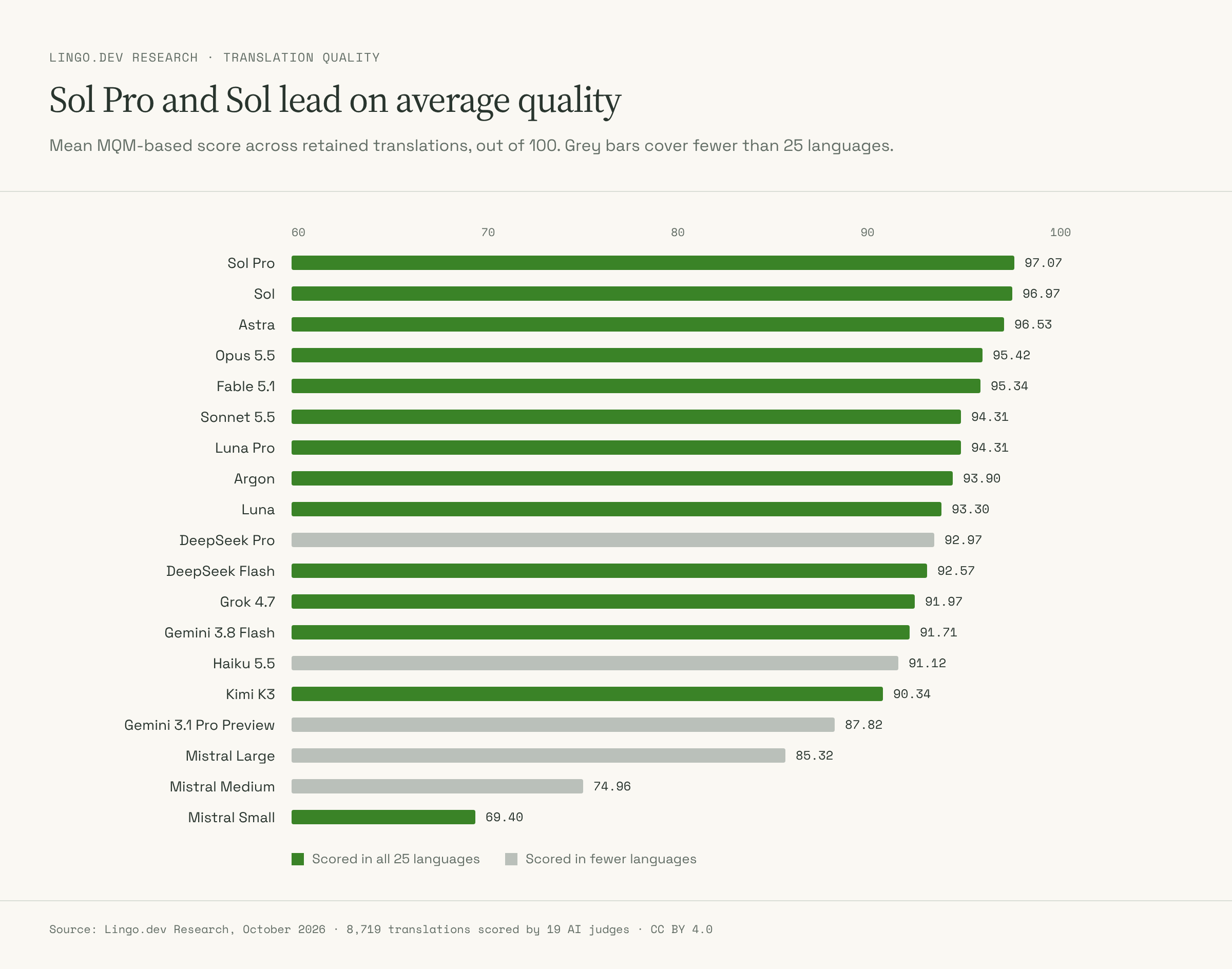
The average becomes more useful when it's read alongside the individual results. Astra scores above 96 overall, for example, but one of its Indonesian translations scores 69.4. That gap is why the following sections look at each language and each model's weakest document: they show where a good overall result still needs closer attention.
The last five models have incomplete language coverage. Their averages omit languages where they failed the delivery check, so they aren't directly comparable with the models scored in all 25 languages.
Which model translates each language best #
The best AI for translation changes by language. Sol Pro leads 13 languages and Sol leads 10. Astra leads Telugu, while Opus 5.5 leads Thai. The table shows the three highest-scoring models in each language.
| Language | 1st | 2nd | 3rd |
|---|---|---|---|
| Bengali | Sol Pro 96.94 | Astra 96.64 | Sol 96.62 |
| Chinese (Simplified) | Sol 98.95 | Sol Pro 98.65 | Astra 98.63 |
| Czech | Sol Pro 97.46 | Sol 97.08 | Astra 96.46 |
| Dutch | Sol Pro 97.29 | Sol 97.21 | Astra 96.28 |
| Estonian | Sol Pro 96.51 | Astra 96.34 | Sol 95.59 |
| French | Sol 97.84 | Sol Pro 97.84 | Fable 5.1 97.50 |
| German | Sol 97.53 | Sol Pro 97.36 | Astra 97.25 |
| Gujarati | Sol Pro 97.36 | Sol 96.96 | Astra 96.62 |
| Hindi | Sol Pro 96.99 | Astra 96.93 | Sol 95.90 |
| Indonesian | Sol 98.20 | Sol Pro 98.04 | Opus 5.5 97.32 |
| Italian | Sol Pro 97.84 | Sol 97.76 | Astra 97.43 |
| Japanese | Sol 98.30 | Sol Pro 98.08 | Opus 5.5 97.43 |
| Korean | Sol Pro 98.00 | Astra 97.88 | Opus 5.5 97.64 |
| Marathi | Sol 96.03 | Sol Pro 95.42 | Fable 5.1 93.73 |
| Polish | Sol 97.86 | Sol Pro 97.30 | Astra 97.03 |
| Portuguese (Brazil) | Sol Pro 98.33 | Astra 97.91 | Sol 97.64 |
| Russian | Sol Pro 97.06 | Sol 96.93 | Astra 96.89 |
| Spanish | Sol Pro 98.16 | Sol 98.15 | Astra 97.31 |
| Swahili | Sol 90.04 | Astra 89.42 | Sol Pro 88.70 |
| Swedish | Sol Pro 97.80 | Sol 97.38 | Opus 5.5 96.99 |
| Tamil | Sol 97.92 | Sol Pro 97.21 | Astra 96.30 |
| Telugu | Astra 95.94 | Sol Pro 95.88 | Sol 95.11 |
| Thai | Opus 5.5 97.73 | Sol 97.64 | Sol Pro 97.57 |
| Turkish | Sol 97.39 | Sol Pro 97.34 | Astra 96.53 |
| Vietnamese | Sol Pro 97.73 | Astra 97.49 | Sol 97.37 |
The overall winner changes when the language changes. Sol leads Japanese and Tamil, while Sol Pro leads Korean. Thai is the clearest exception to OpenAI's lead: Opus 5.5 takes first place there. A localization engine can select a model for each language pair, so the same model doesn't have to handle every market.
A first-place finish also needs context. Sol's leading Swahili score is lower than its overall average, so selecting the winner doesn't remove the need to review the output. For a specific language, the score and the distance to the alternatives are more informative than the model's overall rank.
The language finder on the benchmark index shows these results one language at a time.
If you want to compare every model in every language, here's the full set of scores. I've split it by provider so each table stays readable. "n/a" means the model failed to deliver that language, so it has no score there.
OpenAI: full quality scores by language #
| Language | Sol Pro | Sol | Astra | Luna Pro | Luna |
|---|---|---|---|---|---|
| German | 97.36 | 97.53 | 97.25 | 95.93 | 96.05 |
| French | 97.84 | 97.84 | 97.23 | 96.83 | 95.93 |
| Spanish | 98.16 | 98.15 | 97.31 | 96.41 | 95.59 |
| Italian | 97.84 | 97.76 | 97.43 | 96.52 | 95.26 |
| Portuguese (Brazil) | 98.33 | 97.64 | 97.91 | 97.22 | 96.14 |
| Dutch | 97.29 | 97.21 | 96.28 | 95.33 | 95.57 |
| Swedish | 97.80 | 97.38 | 96.83 | 95.87 | 94.72 |
| Polish | 97.30 | 97.86 | 97.03 | 95.82 | 94.20 |
| Czech | 97.46 | 97.08 | 96.46 | 95.00 | 94.04 |
| Russian | 97.06 | 96.93 | 96.89 | 94.98 | 93.84 |
| Estonian | 96.51 | 95.59 | 96.34 | 92.08 | 89.79 |
| Turkish | 97.34 | 97.39 | 96.53 | 94.59 | 93.44 |
| Japanese | 98.08 | 98.30 | 97.34 | 96.87 | 96.95 |
| Korean | 98.00 | 96.75 | 97.88 | 96.55 | 96.30 |
| Chinese (Simplified) | 98.65 | 98.95 | 98.63 | 97.45 | 96.98 |
| Vietnamese | 97.73 | 97.37 | 97.49 | 96.67 | 96.46 |
| Thai | 97.57 | 97.64 | 96.79 | 95.72 | 94.67 |
| Indonesian | 98.04 | 98.20 | 96.33 | 96.57 | 97.08 |
| Hindi | 96.99 | 95.90 | 96.93 | 92.85 | 92.14 |
| Bengali | 96.94 | 96.62 | 96.64 | 91.54 | 88.45 |
| Tamil | 97.21 | 97.92 | 96.30 | 92.19 | 90.57 |
| Telugu | 95.88 | 95.11 | 95.94 | 87.25 | 85.72 |
| Marathi | 95.42 | 96.03 | 93.56 | 89.62 | 87.45 |
| Gujarati | 97.36 | 96.96 | 96.62 | 90.28 | 89.02 |
| Swahili | 88.70 | 90.04 | 89.42 | 87.52 | 86.23 |
Anthropic: full quality scores by language #
| Language | Opus 5.5 | Fable 5.1 | Sonnet 5.5 | Haiku 5.5 |
|---|---|---|---|---|
| German | 96.54 | 96.10 | 95.19 | 93.41 |
| French | 97.31 | 97.50 | 96.95 | 96.36 |
| Spanish | 96.95 | 97.16 | 96.71 | 94.98 |
| Italian | 96.56 | 96.31 | 94.67 | 94.90 |
| Portuguese (Brazil) | 96.91 | 97.16 | 96.36 | 95.68 |
| Dutch | 95.44 | 95.83 | 94.89 | 91.27 |
| Swedish | 96.99 | 96.88 | 95.51 | 92.95 |
| Polish | 96.25 | 96.75 | 95.37 | 92.92 |
| Czech | 95.21 | 95.75 | 94.39 | 91.40 |
| Russian | 96.60 | 95.97 | 95.04 | 92.73 |
| Estonian | 93.00 | 94.46 | 90.28 | 81.35 |
| Turkish | 95.19 | 95.53 | 93.59 | 88.44 |
| Japanese | 97.43 | 97.35 | 97.08 | 94.88 |
| Korean | 97.64 | 96.63 | 96.89 | 93.99 |
| Chinese (Simplified) | 98.29 | 98.29 | 96.97 | 96.35 |
| Vietnamese | 97.15 | 96.76 | 96.61 | 94.51 |
| Thai | 97.73 | 97.24 | 96.10 | 94.26 |
| Indonesian | 97.32 | 95.74 | 95.09 | 95.15 |
| Hindi | 92.33 | 94.90 | 94.65 | 89.89 |
| Bengali | 92.81 | 91.09 | 93.04 | 85.31 |
| Tamil | 89.67 | 88.51 | 90.24 | 83.08 |
| Telugu | 94.66 | 94.47 | 91.49 | n/a |
| Marathi | 93.18 | 93.73 | 91.89 | 82.58 |
| Gujarati | 95.86 | 94.86 | 94.81 | 90.61 |
| Swahili | 88.49 | 88.59 | 83.90 | 79.91 |
Google: full quality scores by language #
| Language | Argon | Gemini 3.8 Flash | Gemini 3.1 Pro Preview |
|---|---|---|---|
| German | 96.29 | 94.86 | 93.44 |
| French | 96.59 | 94.76 | 92.42 |
| Spanish | 94.15 | 93.80 | 93.08 |
| Italian | 95.04 | 93.02 | n/a |
| Portuguese (Brazil) | 95.41 | 95.42 | 92.29 |
| Dutch | 95.51 | 93.17 | 91.67 |
| Swedish | 95.55 | 92.62 | 92.52 |
| Polish | 94.85 | 93.46 | 90.39 |
| Czech | 94.39 | 94.17 | 91.63 |
| Russian | 94.62 | 92.28 | 91.20 |
| Estonian | 91.79 | 89.35 | 87.28 |
| Turkish | 95.28 | 92.58 | 88.52 |
| Japanese | 96.52 | 94.78 | 94.17 |
| Korean | 96.15 | 92.84 | 90.92 |
| Chinese (Simplified) | 97.60 | 93.07 | 90.95 |
| Vietnamese | 95.69 | 92.87 | 87.74 |
| Thai | 95.00 | 94.25 | 87.85 |
| Indonesian | 95.97 | 95.60 | 91.62 |
| Hindi | 92.53 | 91.98 | 88.00 |
| Bengali | 91.61 | 88.96 | 81.93 |
| Tamil | 87.51 | 82.23 | 75.74 |
| Telugu | 91.30 | 91.17 | 83.57 |
| Marathi | 88.84 | 84.98 | 79.59 |
| Gujarati | 93.64 | 91.74 | 85.42 |
| Swahili | 85.56 | 78.82 | 65.64 |
DeepSeek, xAI, Moonshot and Mistral: full quality scores by language #
| Language | DeepSeek Pro | DeepSeek Flash | Grok 4.7 | Kimi K3 | Mistral Large | Mistral Medium | Mistral Small |
|---|---|---|---|---|---|---|---|
| German | 94.30 | 94.95 | 93.92 | 94.61 | 90.48 | 90.66 | 87.21 |
| French | n/a | 96.62 | 96.66 | 96.57 | 92.72 | 90.41 | 87.61 |
| Spanish | 96.57 | 96.37 | 96.29 | 95.88 | 93.04 | 92.90 | 92.63 |
| Italian | 93.83 | 94.64 | 94.49 | 95.08 | 90.01 | 86.91 | 90.19 |
| Portuguese (Brazil) | 95.64 | 96.41 | 96.21 | 95.53 | 91.87 | 92.02 | 90.53 |
| Dutch | 92.56 | 94.51 | 95.17 | 93.84 | 87.04 | 85.05 | 81.57 |
| Swedish | 93.05 | 94.41 | 95.53 | 94.43 | 87.18 | 87.64 | 79.19 |
| Polish | 93.32 | 93.14 | 94.41 | 94.99 | 88.39 | 83.98 | 85.73 |
| Czech | n/a | 93.19 | 93.09 | 92.62 | 87.93 | 83.35 | 78.71 |
| Russian | 94.59 | 94.06 | 94.23 | 94.00 | 88.28 | 88.47 | 77.86 |
| Estonian | 88.02 | 89.58 | 89.49 | 82.19 | 75.59 | 38.17 | 29.00 |
| Turkish | 91.51 | 93.44 | 92.24 | 93.00 | 83.20 | 80.11 | 75.99 |
| Japanese | 95.23 | 95.44 | 95.85 | 96.64 | 90.28 | 88.08 | 83.43 |
| Korean | 94.81 | 93.64 | 94.69 | 95.75 | 67.56 | 82.08 | 69.26 |
| Chinese (Simplified) | 95.49 | 96.10 | 97.33 | 95.95 | 92.63 | 92.75 | 89.56 |
| Vietnamese | 93.16 | 94.55 | 93.74 | 95.03 | 87.55 | 84.37 | 84.64 |
| Thai | 93.55 | 93.46 | 94.35 | 94.15 | 85.33 | 78.92 | 77.23 |
| Indonesian | n/a | 93.23 | 94.46 | 95.45 | 87.72 | 86.58 | 85.29 |
| Hindi | 91.88 | 91.20 | 88.34 | 91.27 | n/a | 82.32 | 75.19 |
| Bengali | 89.44 | 88.70 | 85.47 | 86.42 | n/a | 75.74 | 69.44 |
| Tamil | n/a | 88.39 | 87.48 | 76.38 | n/a | n/a | 50.59 |
| Telugu | 88.86 | 90.54 | 88.62 | 85.42 | n/a | n/a | 54.00 |
| Marathi | n/a | 88.19 | 79.28 | 79.40 | n/a | 61.07 | 61.79 |
| Gujarati | 90.65 | 92.37 | 87.38 | 84.42 | n/a | 65.81 | 63.35 |
| Swahili | n/a | 76.35 | 80.55 | 59.05 | 54.32 | -73.20 | -85.08 |
How consistent is each model? #
Some models produce good translations most of the time but occasionally fall well below their average. Sol has the highest weakest-document score in this test, while Sol Pro has a document below 80 in the fewest languages.
The table shows both how far quality fell and how many scored languages contained at least one document below 80.
| Model | Mean quality | Weakest single document | Language of weakest document | Languages with a document below 80 |
|---|---|---|---|---|
| Sol Pro | 97.07 | 67.9 | Swahili | 1 of 25 |
| Sol | 96.97 | 72.9 | Swahili | 2 of 25 |
| Astra | 96.53 | 69.4 | Indonesian | 2 of 25 |
| Opus 5.5 | 95.42 | 57.3 | Hindi | 4 of 25 |
| Fable 5.1 | 95.34 | 66.5 | Swahili | 5 of 25 |
| Sonnet 5.5 | 94.31 | 53.1 | Telugu | 6 of 25 |
| Luna Pro | 94.31 | 4.1 | Telugu | 7 of 25 |
| Argon | 93.90 | 57.7 | Tamil | 8 of 25 |
| Luna | 93.30 | -10.9 | Telugu | 8 of 25 |
| DeepSeek Pro | 92.97 | 61.7 | Telugu | 5 of 19 |
| DeepSeek Flash | 92.57 | 50.2 | Swahili | 7 of 25 |
| Grok 4.7 | 91.97 | 22.0 | Marathi | 7 of 25 |
| Gemini 3.8 Flash | 91.71 | 48.6 | Swahili | 10 of 25 |
| Haiku 5.5 | 91.12 | 50.3 | Tamil | 8 of 24 |
| Kimi K3 | 90.34 | 17.8 | Swahili | 8 of 25 |
| Gemini 3.1 Pro Preview | 87.82 | 35.5 | Marathi | 15 of 24 |
| Mistral Large | 85.32 | -19.1 | Swahili | 17 of 19 |
| Mistral Medium | 74.96 | -202.7 | Swahili | 22 of 23 |
| Mistral Small | 69.40 | -211.3 | Swahili | 24 of 25 |
Indonesian gives a useful example of why these columns belong together. Astra and Argon have similar averages, 96.33 and 95.97, but their weakest documents score 69.4 and 91.3. Looking only at the averages would make the models seem much closer than their weakest translations suggest.
The language count adds another part of the picture. Sol Pro has a document below 80 in one language, while Mistral Small does in 24. One result points to a weakness in a particular language; the other shows low scores across almost the entire test.
Luna Pro and Luna illustrate why this matters for lower-cost models. Their overall averages are much higher than their weakest Telugu scores of 4.1 and -10.9. Average quality alone would hide those documents.
See how your own translations score #
A good average can still hide a weak document, as the results above show. To check a translation from your own product, request a free translation quality assessment. Upload the source and translated documents, or share links to both pages, to request a private MQM-based report with flagged passages and error severities.
Which languages are hardest for LLMs to translate? #
Swahili has the lowest leading score in this test, even when using its best-performing model. Spanish has the smallest difference between models. The chart and table show the best and weakest model average for every language.
The translation quality gap is the distance between those two averages.
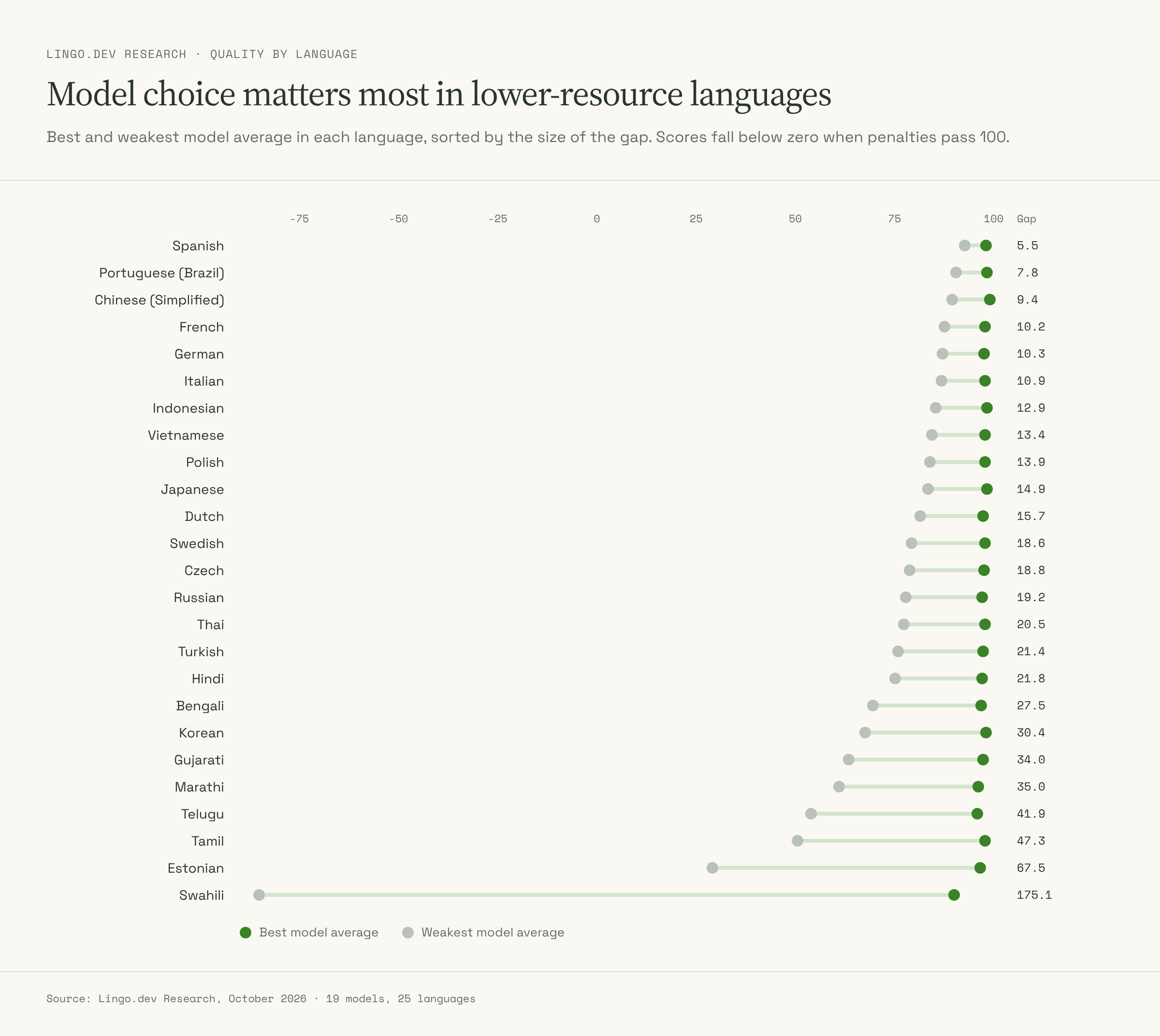
The longer the line in the chart, the more the tested models disagree in quality for that language. The table below names the models at each end, which helps distinguish a difficult language from a particularly weak model result.
| Language | Best model | Weakest model | Gap (points) | Models scored |
|---|---|---|---|---|
| Spanish | Sol Pro (98.16) | Mistral Small (92.63) | 5.5 | 19 |
| Portuguese (Brazil) | Sol Pro (98.33) | Mistral Small (90.53) | 7.8 | 19 |
| Chinese (Simplified) | Sol (98.95) | Mistral Small (89.56) | 9.4 | 19 |
| French | Sol (97.84) | Mistral Small (87.61) | 10.2 | 18 |
| German | Sol (97.53) | Mistral Small (87.21) | 10.3 | 19 |
| Italian | Sol Pro (97.84) | Mistral Medium (86.91) | 10.9 | 18 |
| Indonesian | Sol (98.20) | Mistral Small (85.29) | 12.9 | 18 |
| Vietnamese | Sol Pro (97.73) | Mistral Medium (84.37) | 13.4 | 19 |
| Polish | Sol (97.86) | Mistral Medium (83.98) | 13.9 | 19 |
| Japanese | Sol (98.30) | Mistral Small (83.43) | 14.9 | 19 |
| Dutch | Sol Pro (97.29) | Mistral Small (81.57) | 15.7 | 19 |
| Swedish | Sol Pro (97.80) | Mistral Small (79.19) | 18.6 | 19 |
| Czech | Sol Pro (97.46) | Mistral Small (78.71) | 18.8 | 18 |
| Russian | Sol Pro (97.06) | Mistral Small (77.86) | 19.2 | 19 |
| Thai | Opus 5.5 (97.73) | Mistral Small (77.23) | 20.5 | 19 |
| Turkish | Sol (97.39) | Mistral Small (75.99) | 21.4 | 19 |
| Hindi | Sol Pro (96.99) | Mistral Small (75.19) | 21.8 | 18 |
| Bengali | Sol Pro (96.94) | Mistral Small (69.44) | 27.5 | 18 |
| Korean | Sol Pro (98.00) | Mistral Large (67.56) | 30.4 | 19 |
| Gujarati | Sol Pro (97.36) | Mistral Small (63.35) | 34.0 | 18 |
| Marathi | Sol (96.03) | Mistral Medium (61.07) | 35.0 | 17 |
| Telugu | Astra (95.94) | Mistral Small (54.00) | 41.9 | 16 |
| Tamil | Sol (97.92) | Mistral Small (50.59) | 47.3 | 16 |
| Estonian | Sol Pro (96.51) | Mistral Small (29.00) | 67.5 | 19 |
| Swahili | Sol (90.04) | Mistral Small (-85.08) | 175.1 | 18 |
A language can be difficult even for the strongest model, or it can have a large gap between strong and weak models. Swahili shows both: its leading score is lower than every other language's leading score, and its spread is the widest in the test.
Estonian shows why model selection matters. Its scores range from 29.00 to 96.51, while every Spanish model average stays above 92. The Spanish results give more closely scored alternatives; the Estonian results make a weak model choice much more consequential.
A narrow gap still says nothing about the weakest individual document. These are language averages, so the consistency results remain relevant even where the models appear close.
How much does LLM translation cost? #
Translation cost depends on both the model and the target language. The comparisons below look at the cost of each model, how that cost changes by language, and how listed token prices compare with the recorded bill.
Which LLM is cheapest for translation? #
Luna has the lowest recorded translation cost in this benchmark, and Fable 5.1 has the highest. The AI model comparison below pairs each model's cost with its quality score and language coverage, from cheapest to most expensive.
Costs are USD per 100 documents retained for quality scoring.
| Model | USD per 100 documents | Mean quality | Languages scored |
|---|---|---|---|
| Luna | $0.19 | 93.30 | 25 |
| Haiku 5.5 | $0.36 | 91.12 | 24 |
| Mistral Small | $0.43 | 69.40 | 25 |
| Luna Pro | $0.66 | 94.31 | 25 |
| DeepSeek Flash | $1.94 | 92.57 | 25 |
| Gemini 3.8 Flash | $2.17 | 91.71 | 25 |
| DeepSeek Pro | $2.58 | 92.97 | 19 |
| Argon | $2.78 | 93.90 | 25 |
| Sol | $3.34 | 96.97 | 25 |
| Mistral Large | $3.42 | 85.32 | 19 |
| Grok 4.7 | $3.61 | 91.97 | 25 |
| Kimi K3 | $5.84 | 90.34 | 25 |
| Sonnet 5.5 | $5.96 | 94.31 | 25 |
| Opus 5.5 | $11.54 | 95.42 | 25 |
| Sol Pro | $11.77 | 97.07 | 25 |
| Gemini 3.1 Pro Preview | $11.83 | 87.82 | 24 |
| Mistral Medium | $12.62 | 74.96 | 23 |
| Astra | $16.54 | 96.53 | 25 |
| Fable 5.1 | $37.28 | 95.34 | 25 |
A higher cost doesn't consistently bring a higher quality score. Luna Pro and Sonnet 5.5 have the same average score, even though Sonnet costs about nine times as much. Sol Pro gains only a small increase in average quality over Sol for more than three times the recorded cost. At the most expensive end, Fable still doesn't lead any language.
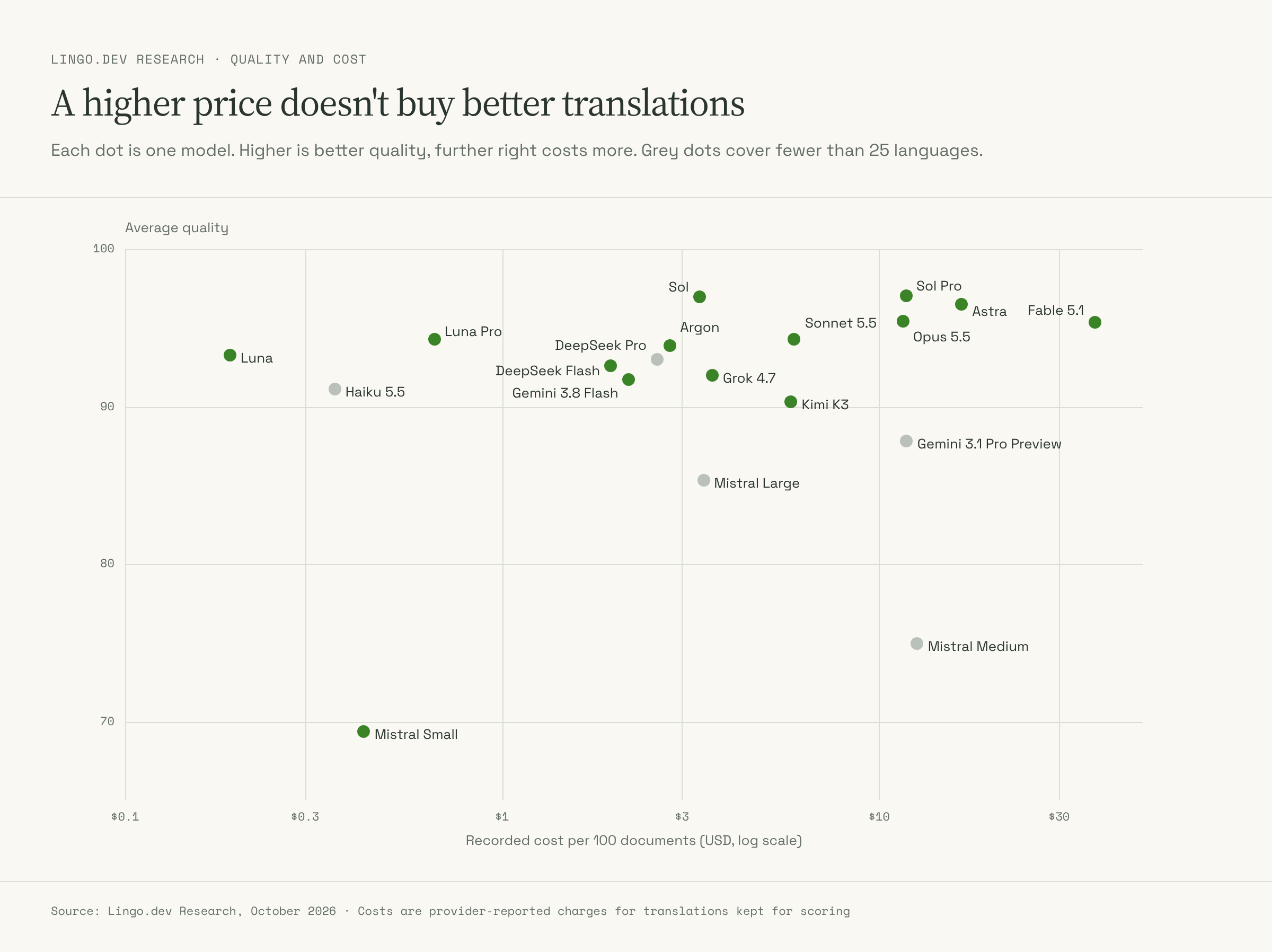
The useful question is what the extra spend changes in the finished translation. A higher average may matter less if it comes from languages outside your product's markets, or if the model still produces weak documents in a language you need. The language and consistency tables let you check those differences before treating a higher price as an improvement.
These are model charges. They don't include the cost of reviewing or repairing translations, so a cheaper response doesn't necessarily mean a cheaper finished workflow. Models with incomplete language coverage also omit failed languages from these cost averages.
How does translation cost vary by language? #
Tamil is the most expensive language to translate on average in this test, and Chinese (Simplified) is the cheapest. The comparison holds the source documents fixed and averages recorded costs across all 19 models.
Costs are whole-response charges in USD per 100 successful translation calls, including responses later excluded from quality scoring.
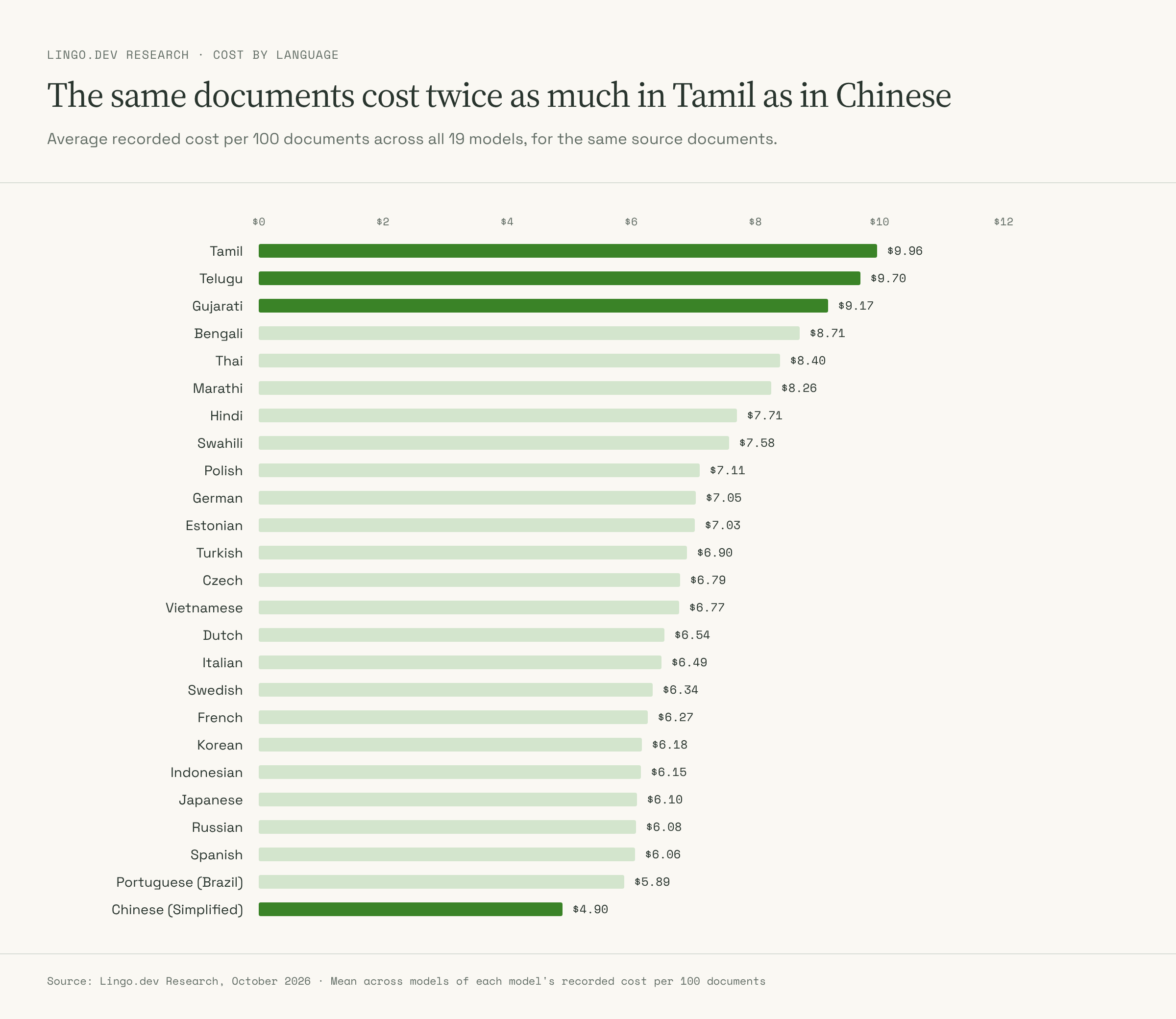
The chart shows the average across models. The table adds the cheapest and most expensive model in each language, so you can see how much the model choice changes that average.
| Language | Average cost | Cheapest model | Most expensive model |
|---|---|---|---|
| Tamil | $9.96 | Luna ($0.25) | Fable 5.1 ($58.67) |
| Telugu | $9.70 | Luna ($0.23) | Fable 5.1 ($52.77) |
| Gujarati | $9.17 | Luna ($0.21) | Fable 5.1 ($49.27) |
| Bengali | $8.71 | Luna ($0.21) | Fable 5.1 ($52.27) |
| Thai | $8.40 | Luna ($0.20) | Fable 5.1 ($48.47) |
| Marathi | $8.26 | Luna ($0.21) | Fable 5.1 ($46.72) |
| Hindi | $7.71 | Luna ($0.19) | Fable 5.1 ($43.95) |
| Swahili | $7.58 | Luna ($0.20) | Fable 5.1 ($38.10) |
| Polish | $7.11 | Luna ($0.20) | Fable 5.1 ($34.29) |
| German | $7.05 | Luna ($0.18) | Fable 5.1 ($37.91) |
| Estonian | $7.03 | Luna ($0.18) | Fable 5.1 ($33.38) |
| Turkish | $6.90 | Luna ($0.19) | Fable 5.1 ($35.71) |
| Czech | $6.79 | Luna ($0.20) | Fable 5.1 ($31.47) |
| Vietnamese | $6.77 | Luna ($0.18) | Fable 5.1 ($37.80) |
| Dutch | $6.54 | Luna ($0.16) | Fable 5.1 ($33.07) |
| Italian | $6.49 | Luna ($0.19) | Fable 5.1 ($31.65) |
| Swedish | $6.34 | Luna ($0.18) | Fable 5.1 ($29.72) |
| French | $6.27 | Luna ($0.17) | Fable 5.1 ($31.52) |
| Korean | $6.18 | Luna ($0.17) | Fable 5.1 ($32.31) |
| Indonesian | $6.15 | Luna ($0.16) | Fable 5.1 ($32.85) |
| Japanese | $6.10 | Luna ($0.20) | Fable 5.1 ($27.52) |
| Russian | $6.08 | Luna ($0.16) | Fable 5.1 ($29.35) |
| Spanish | $6.06 | Luna ($0.16) | Fable 5.1 ($30.25) |
| Portuguese (Brazil) | $5.89 | Luna ($0.16) | Fable 5.1 ($29.66) |
| Chinese (Simplified) | $4.90 | Luna ($0.13) | Fable 5.1 ($23.24) |
A single cost estimate can hide a large language difference. Telugu, Gujarati and Bengali sit near Tamil at the expensive end, while Chinese costs roughly half as much as Tamil on average.
The size of that difference depends on the model. Tamil costs 3.99 times as much as Chinese with Kimi K3, compared with 1.39 times with Gemini 3.8 Flash. A language multiplier taken from one model would give a misleading estimate for another.
Output length, tokenization and reported reasoning can all affect billed usage. This test records their combined cost; it doesn't isolate each factor's contribution. The model-language tables provide the relevant totals for a multilingual budget. The guide on controlling localization cost without hiding failures covers review, retries and the rest of that budget.
And here's how much more Tamil cost than Chinese (Simplified) with each model:
| Model | Chinese (Simplified) | Tamil | Tamil costs |
|---|---|---|---|
| Kimi K3 | $2.50 | $9.98 | 3.99x |
| Haiku 5.5 | $0.22 | $0.63 | 2.92x |
| DeepSeek Pro | $1.33 | $3.64 | 2.74x |
| Opus 5.5 | $7.18 | $18.35 | 2.56x |
| Fable 5.1 | $23.24 | $58.67 | 2.52x |
| Sonnet 5.5 | $3.78 | $9.47 | 2.51x |
| DeepSeek Flash | $1.14 | $2.63 | 2.30x |
| Grok 4.7 | $2.42 | $4.96 | 2.05x |
| Mistral Large | $2.98 | $5.90 | 1.98x |
| Luna | $0.13 | $0.25 | 1.83x |
| Sol Pro | $8.97 | $15.98 | 1.78x |
| Sol | $2.58 | $4.40 | 1.71x |
| Argon | $1.98 | $3.35 | 1.69x |
| Astra | $12.94 | $21.83 | 1.69x |
| Luna Pro | $0.52 | $0.86 | 1.66x |
| Mistral Medium | $9.42 | $13.12 | 1.39x |
| Gemini 3.8 Flash | $1.62 | $2.25 | 1.39x |
| Gemini 3.1 Pro Preview | $9.76 | $12.57 | 1.29x |
| Mistral Small | $0.38 | $0.47 | 1.22x |
If you want the exact cost for a model and language, here's the full table, split by provider:
OpenAI: full translation costs by language #
| Language | Sol Pro | Sol | Astra | Luna Pro | Luna |
|---|---|---|---|---|---|
| German | $10.58 | $3.07 | $15.02 | $0.60 | $0.18 |
| French | $10.61 | $2.98 | $15.17 | $0.59 | $0.17 |
| Spanish | $9.62 | $2.81 | $13.78 | $0.56 | $0.16 |
| Italian | $11.66 | $3.26 | $15.98 | $0.63 | $0.19 |
| Portuguese (Brazil) | $9.49 | $2.66 | $13.35 | $0.55 | $0.16 |
| Dutch | $9.83 | $2.81 | $13.97 | $0.57 | $0.16 |
| Swedish | $11.46 | $3.15 | $15.50 | $0.64 | $0.18 |
| Polish | $13.12 | $3.69 | $17.87 | $0.73 | $0.20 |
| Czech | $12.39 | $3.62 | $17.65 | $0.71 | $0.20 |
| Russian | $10.40 | $3.02 | $14.77 | $0.60 | $0.16 |
| Estonian | $11.80 | $3.23 | $16.27 | $0.67 | $0.18 |
| Turkish | $11.52 | $3.36 | $16.39 | $0.66 | $0.19 |
| Japanese | $12.23 | $3.55 | $17.30 | $0.71 | $0.20 |
| Korean | $10.12 | $2.96 | $14.35 | $0.58 | $0.17 |
| Chinese (Simplified) | $8.97 | $2.58 | $12.94 | $0.52 | $0.13 |
| Vietnamese | $10.87 | $3.25 | $15.46 | $0.63 | $0.18 |
| Thai | $13.67 | $3.82 | $18.72 | $0.74 | $0.20 |
| Indonesian | $9.96 | $2.78 | $14.06 | $0.58 | $0.16 |
| Hindi | $12.11 | $3.40 | $17.36 | $0.68 | $0.19 |
| Bengali | $13.58 | $3.79 | $18.56 | $0.74 | $0.21 |
| Tamil | $15.98 | $4.40 | $21.83 | $0.86 | $0.25 |
| Telugu | $14.71 | $4.08 | $20.95 | $0.84 | $0.23 |
| Marathi | $13.19 | $3.75 | $19.54 | $0.73 | $0.21 |
| Gujarati | $14.06 | $3.83 | $19.25 | $0.74 | $0.21 |
| Swahili | $12.43 | $3.51 | $17.58 | $0.72 | $0.20 |
Anthropic: full translation costs by language #
| Language | Opus 5.5 | Fable 5.1 | Sonnet 5.5 | Haiku 5.5 |
|---|---|---|---|---|
| German | $11.67 | $37.91 | $6.09 | $0.40 |
| French | $9.67 | $31.52 | $5.05 | $0.28 |
| Spanish | $9.28 | $30.25 | $4.66 | $0.26 |
| Italian | $9.71 | $31.65 | $5.08 | $0.27 |
| Portuguese (Brazil) | $9.14 | $29.66 | $4.76 | $0.28 |
| Dutch | $10.18 | $33.07 | $5.30 | $0.29 |
| Swedish | $9.13 | $29.72 | $4.76 | $0.30 |
| Polish | $10.43 | $34.29 | $5.44 | $0.33 |
| Czech | $9.78 | $31.47 | $5.08 | $0.40 |
| Russian | $8.98 | $29.35 | $4.67 | $0.26 |
| Estonian | $9.81 | $33.38 | $5.09 | $0.37 |
| Turkish | $11.04 | $35.71 | $5.67 | $0.37 |
| Japanese | $8.45 | $27.52 | $4.44 | $0.24 |
| Korean | $9.96 | $32.31 | $5.22 | $0.30 |
| Chinese (Simplified) | $7.18 | $23.24 | $3.78 | $0.22 |
| Vietnamese | $11.65 | $37.80 | $6.05 | $0.33 |
| Thai | $15.21 | $48.47 | $7.82 | $0.50 |
| Indonesian | $10.03 | $32.85 | $5.43 | $0.32 |
| Hindi | $13.36 | $43.95 | $7.05 | $0.39 |
| Bengali | $15.96 | $52.27 | $7.89 | $0.52 |
| Tamil | $18.35 | $58.67 | $9.47 | $0.63 |
| Telugu | $17.64 | $52.77 | $8.61 | $0.59 |
| Marathi | $14.38 | $46.72 | $7.42 | $0.47 |
| Gujarati | $15.76 | $49.27 | $8.36 | $0.61 |
| Swahili | $11.82 | $38.10 | $5.84 | $0.43 |
Google: full translation costs by language #
| Language | Argon | Gemini 3.8 Flash | Gemini 3.1 Pro Preview |
|---|---|---|---|
| German | $2.64 | $2.17 | $11.64 |
| French | $2.62 | $2.03 | $11.75 |
| Spanish | $2.35 | $1.94 | $12.21 |
| Italian | $2.65 | $2.17 | $11.72 |
| Portuguese (Brazil) | $2.36 | $2.01 | $11.59 |
| Dutch | $2.70 | $2.19 | $13.57 |
| Swedish | $2.73 | $2.26 | $11.83 |
| Polish | $2.81 | $2.35 | $13.20 |
| Czech | $2.91 | $2.41 | $12.03 |
| Russian | $2.50 | $2.01 | $11.64 |
| Estonian | $3.10 | $2.37 | $15.18 |
| Turkish | $2.64 | $2.21 | $11.98 |
| Japanese | $2.24 | $1.85 | $9.76 |
| Korean | $2.29 | $2.07 | $11.37 |
| Chinese (Simplified) | $1.98 | $1.62 | $9.76 |
| Vietnamese | $2.62 | $2.03 | $10.94 |
| Thai | $2.72 | $2.16 | $10.39 |
| Indonesian | $2.24 | $1.89 | $11.46 |
| Hindi | $2.89 | $1.99 | $10.88 |
| Bengali | $3.08 | $2.04 | $10.75 |
| Tamil | $3.35 | $2.25 | $12.57 |
| Telugu | $3.78 | $2.76 | $12.83 |
| Marathi | $3.10 | $2.16 | $9.95 |
| Gujarati | $3.88 | $2.77 | $13.49 |
| Swahili | $3.30 | $2.60 | $13.23 |
DeepSeek, xAI, Moonshot and Mistral: full translation costs by language #
| Language | DeepSeek Pro | DeepSeek Flash | Grok 4.7 | Kimi K3 | Mistral Large | Mistral Medium | Mistral Small |
|---|---|---|---|---|---|---|---|
| German | $2.28 | $1.72 | $3.33 | $4.84 | $3.24 | $16.19 | $0.37 |
| French | $2.28 | $1.67 | $3.02 | $4.85 | $3.41 | $10.98 | $0.36 |
| Spanish | $2.02 | $1.57 | $2.98 | $4.52 | $2.99 | $12.83 | $0.36 |
| Italian | $2.12 | $1.74 | $3.20 | $4.79 | $2.98 | $13.06 | $0.38 |
| Portuguese (Brazil) | $2.25 | $1.50 | $3.16 | $4.31 | $2.87 | $11.43 | $0.33 |
| Dutch | $2.18 | $1.79 | $3.36 | $4.59 | $2.90 | $14.48 | $0.39 |
| Swedish | $2.16 | $1.81 | $3.25 | $4.87 | $3.62 | $12.74 | $0.39 |
| Polish | $2.50 | $1.71 | $3.26 | $5.57 | $3.83 | $13.25 | $0.43 |
| Czech | $2.23 | $1.84 | $3.41 | $5.68 | $3.90 | $12.82 | $0.51 |
| Russian | $2.27 | $1.72 | $2.94 | $5.44 | $3.20 | $11.18 | $0.44 |
| Estonian | $2.25 | $2.03 | $3.50 | $4.87 | $3.72 | $15.29 | $0.46 |
| Turkish | $2.84 | $1.95 | $3.21 | $5.48 | $3.12 | $12.46 | $0.40 |
| Japanese | $2.13 | $1.58 | $2.88 | $4.27 | $3.54 | $12.61 | $0.41 |
| Korean | $2.11 | $1.61 | $3.31 | $4.59 | $3.72 | $10.03 | $0.37 |
| Chinese (Simplified) | $1.33 | $1.14 | $2.42 | $2.50 | $2.98 | $9.42 | $0.38 |
| Vietnamese | $2.59 | $2.00 | $2.97 | $7.27 | $3.21 | $8.46 | $0.36 |
| Thai | $2.39 | $1.62 | $3.28 | $8.03 | $4.41 | $14.97 | $0.50 |
| Indonesian | $1.97 | $1.46 | $2.78 | $4.29 | $3.35 | $10.85 | $0.38 |
| Hindi | $3.53 | $2.44 | $3.37 | $6.99 | $4.83 | $10.64 | $0.42 |
| Bengali | $2.80 | $2.06 | $4.37 | $7.39 | $5.32 | $13.71 | $0.46 |
| Tamil | $3.64 | $2.63 | $4.96 | $9.98 | $5.90 | $13.12 | $0.47 |
| Telugu | $4.70 | $3.29 | $7.05 | $9.71 | $4.52 | $14.53 | $0.64 |
| Marathi | $3.25 | $2.41 | $3.79 | $7.20 | $5.48 | $12.66 | $0.51 |
| Gujarati | $4.58 | $3.18 | $6.41 | $8.85 | $4.27 | $14.22 | $0.58 |
| Swahili | $2.46 | $2.10 | $4.17 | $5.12 | $4.06 | $15.97 | $0.41 |
How listed prices compare with actual translation costs #
The models with the lowest token prices aren't always the cheapest to use. The table compares every model's listed output price with its recorded translation cost, sorted from the lowest actual cost to the highest.
| Model | Listed output price (USD / million tokens) | Recorded cost (USD / 100 translations) |
|---|---|---|
| Luna | $0.50 | $0.19 |
| Haiku 5.5 | $0.50 | $0.37 |
| Mistral Small | $0.60 | $0.43 |
| Luna Pro | $0.50 | $0.66 |
| DeepSeek Flash | $1.20 | $1.94 |
| Gemini 3.8 Flash | $3.75 | $2.17 |
| DeepSeek Pro | $1.98 | $2.60 |
| Argon | $10.00 | $2.78 |
| Sol | $10.00 | $3.34 |
| Grok 4.7 | $6.00 | $3.61 |
| Mistral Large | $2.09 | $3.81 |
| Kimi K3 | $15.00 | $5.84 |
| Sonnet 5.5 | $10.00 | $5.96 |
| Opus 5.5 | $20.00 | $11.54 |
| Sol Pro | $10.00 | $11.77 |
| Gemini 3.1 Pro Preview | $12.00 | $11.83 |
| Mistral Medium | $7.50 | $12.72 |
| Astra | $50.00 | $16.54 |
| Fable 5.1 | $50.00 | $37.28 |
Several models share a listed output price but produce different bills because they use different numbers of tokens to translate the same documents. Sol Pro, for example, averages 4,921 reported output tokens per translation, compared with Sol's 2,429, even though both charge $10 per million output tokens. Output usage can include hidden reasoning as well as the visible translation, and the recorded bill also includes input usage. That means the output-token price alone can't predict the total cost: both the amount used and the input charges matter.
Reported reasoning usage adds another difference. Four models report that more than half their output tokens are reasoning: Mistral Large, Mistral Medium, DeepSeek Flash and Mistral Small. Those tokens don't appear in the translation, but they contribute to the usage being billed.
The recorded cost includes input and output usage, so the output price alone can't explain the whole bill. For a translation budget, the actual cost of the same documents is the more useful comparison.
Input prices, reasoning usage and cost calculation notes #
The following table keeps the remaining pricing and usage data separate from the main comparison.
| Model | Input price (USD / million tokens) | Reported reasoning share |
|---|---|---|
| Luna | $0.10 | 1.5% |
| Haiku 5.5 | $0.10 | 21.2% |
| Mistral Small | $0.15 | 56.5% |
| Luna Pro | $0.10 | 4.8% |
| DeepSeek Flash | $0.30 | 60.7% |
| Gemini 3.8 Flash | $0.75 | 0.0% |
| DeepSeek Pro | $0.66 | 0.0% |
| Argon | $2.00 | 0.0% |
| Sol | $2.00 | 0.1% |
| Grok 4.7 | $2.00 | 6.1% |
| Mistral Large | $0.68 | 69.3% |
| Kimi K3 | $0.50 | 0.7% |
| Sonnet 5.5 | $2.00 | 0.0% |
| Opus 5.5 | $4.00 | 0.0% |
| Sol Pro | $2.00 | 1.1% |
| Gemini 3.1 Pro Preview | $2.00 | 48.3% |
| Mistral Medium | $1.50 | 69.0% |
| Astra | $10.00 | 0.0% |
| Fable 5.1 | $10.00 | 0.0% |
These costs come from the October 2026 test. This table includes completed requests even when the model returned the wrong language. The earlier table leaves those results out, which is why Mistral Medium's average cost differs slightly: $12.62 there and $12.72 here.
A 0.0% reasoning share means the provider reported no reasoning tokens; it doesn't prove none were used.
Which LLM translates fastest? #
Luna has the fastest median translation time in this test, while Mistral Large has the slowest. The table compares a typical request using the median and slower requests using P95, the observed 95th-percentile time.
All timings include network and queueing.
| Model | Median seconds | P95 seconds | Reasoning share of output tokens |
|---|---|---|---|
| Luna | 15.4 | 33.6 | 1.5% |
| Gemini 3.8 Flash | 19.0 | 28.5 | 0.0% |
| Luna Pro | 20.9 | 37.1 | 4.8% |
| DeepSeek Flash | 21.0 | 53.7 | 60.7% |
| DeepSeek Pro | 21.9 | 55.7 | 0.0% |
| Haiku 5.5 | 24.5 | 55.8 | 21.2% |
| Astra | 27.8 | 92.2 | 0.0% |
| Sol | 28.4 | 80.3 | 0.1% |
| Argon | 30.0 | 48.2 | 0.0% |
| Sonnet 5.5 | 33.5 | 61.3 | 0.0% |
| Gemini 3.1 Pro Preview | 35.3 | 75.7 | 48.3% |
| Grok 4.7 | 40.4 | 113.6 | 6.1% |
| Sol Pro | 41.3 | 111.1 | 1.1% |
| Kimi K3 | 41.9 | 88.8 | 0.7% |
| Mistral Small | 43.3 | 109.4 | 56.5% |
| Fable 5.1 | 52.6 | 298.6 | 0.0% |
| Opus 5.5 | 64.3 | 124.0 | 0.0% |
| Mistral Medium | 110.4 | 275.3 | 69.0% |
| Mistral Large | 156.3 | 581.7 | 69.3% |
The difference between median and P95 matters when someone is waiting for the translation. Fable 5.1's median is under a minute, but its P95 is close to five minutes. A typical-time figure alone would hide those longer waits.
Luna, Gemini 3.8 Flash and Luna Pro have the three fastest medians, but quality and delivery still need a separate check. A fast response can contain translation errors or return the wrong language.
Reported reasoning share describes token usage, and these measurements don't establish that reasoning alone causes latency differences. A 0.0% share means the provider reported no reasoning tokens; it doesn't prove none were used. These timings describe this run, rather than guaranteed provider response times.
Which models failed to deliver every language? #
127 of 9,025 translations fail the language check: 117 use the wrong script and 10 return the English source unchanged. The table lists every affected model-language pair and the failed document count out of 19.
| Model | Language | Failed translations (of 19) | What came back |
|---|---|---|---|
| Mistral Large | Bengali | 19 | Wrong script |
| Mistral Large | Gujarati | 19 | Wrong script |
| Mistral Large | Hindi | 19 | Wrong script |
| Mistral Large | Marathi | 19 | Wrong script |
| Mistral Large | Tamil | 19 | Wrong script |
| Mistral Large | Telugu | 19 | Wrong script |
| DeepSeek Pro | Tamil | 4 | English source unchanged |
| DeepSeek Pro | Czech | 1 | English source unchanged |
| DeepSeek Pro | French | 1 | English source unchanged |
| DeepSeek Pro | Indonesian | 1 | English source unchanged |
| DeepSeek Pro | Marathi | 1 | English source unchanged |
| DeepSeek Pro | Swahili | 1 | English source unchanged |
| Gemini 3.1 Pro Preview | Italian | 1 | English source unchanged |
| Mistral Medium | Tamil | 1 | Wrong script |
| Mistral Medium | Telugu | 1 | Wrong script |
| Haiku 5.5 | Telugu | 1 | Wrong script |
Mistral Large accounts for most failures, using the wrong script for every document in six Indian languages. Other models fail less often, but even an isolated failure means a completed request can't be assumed to contain a usable translation.
I excluded a model's results in a language if it failed the delivery check even once there. That rule explains the missing scores in the quality tables: a blank cell indicates a delivery failure, rather than an untested language or a quality score of zero.
This is also why coverage belongs beside average quality and cost. A model's retained results can look stronger after its failed languages have been excluded. Checking the returned language before accepting a translation catches a failure that the response status alone misses. Our guide to comparing translation models explains how to preserve failed attempts alongside successful results.
What this benchmark doesn't tell you #
Like any LLM translation benchmark, this is one controlled test. Keep these limits in mind when you apply the results:
- AI judges. Models judged every translation, including their own. With 19 judges per translation, no single one carries much weight. These are still AI judgments, so I've published the method, the exclusions and the data for you to check.
- One kind of content. The source documents are product copy and documentation for a fictional B2B SaaS company. Marketing, legal or support content might rank models differently.
- English source only. Every translation in this LLM comparison starts from English. The results don't establish performance between other language pairs.
- Fixed settings. Translation ran with minimal reasoning. Other settings, or the glossaries and rules a production pipeline adds, can change the results.
- A snapshot. Models and prices change quickly. These results reflect October 2026.
The costs are charges each provider reported per response, not invoice totals. And the scores aren't percentages.
How to choose an LLM for your translation pipeline #
The best translation model for your product depends on the languages you ship, the quality you need and the cost you can support. Reading the benchmark's quality, cost and reliability results together helps narrow the choice without assuming that the overall winner will suit every translation job.
Start with the languages you need. The per-language table gives the three highest-scoring models for each language. Thai points to Opus 5.5, while Telugu points to Astra. For a product shipping in several languages, compare those rows before choosing one default model.
Check what the extra cost buys. Use the cost table to compare models with similar quality scores. Luna Pro and Sonnet 5.5 have the same mean score at very different prices. Sol and Sol Pro show a different trade-off: a small difference in average quality alongside a much larger difference in cost. The language-level results show whether that extra spend improves the translations your product actually needs.
Look for weak documents behind a good average. The consistency table shows how far a model's weakest result falls and how many languages contain a document below 80. Luna Pro's overall average looks strong, but its weakest Telugu document needs much closer attention. For content where an error changes a price, instruction or commitment, inspect the affected passages before relying on an average score.
Keep failed languages in the decision. A missing quality score means the model failed the delivery check for that language. A model scored in 19 languages can't be treated as an equally complete alternative to one scored in all 25. Keep language checks, retries and any fallback model in the evaluation, including their cost.
Compare the remaining candidates on your own content. Use the same source documents, target languages, context and settings for each model, then evaluate the outputs against the same criteria. Include ordinary product copy as well as difficult terminology and instructions, and retain failed attempts alongside successful ones. Our guide to comparing translation models walks through that process.
Automate the process using a localization engine. Testing several models and using different ones for different languages can mean repeatedly setting up the same model choices and product guidance. A localization engine keeps that setup in one place and applies it to recurring translation requests. With Lingo.dev, you can choose models for each language pair and reuse your glossary, rules and brand voice across requests. That reduces repeated configuration work as you test and translate more content. The localization engine guide explains how to connect the saved setup to your product's translation workflow.
This gives you a decision you can explain: which model works for which languages and content, what it costs, and where review is still needed. It also gives you a baseline to revisit when a model, prompt or product requirement changes.
Quality also needs checking after a model is selected. Radar's MQM measurement can flag errors in ongoing translations; the Radar release update shows how those checks work in the product.
Frequently asked questions #
What is the best LLM for translation? #
In my October 2026 benchmark, Sol Pro had the highest average quality, 97.07 across 25 languages. Sol came a close second at 96.97 and costs less than a third as much. The leader still changes by language, so check the per-language table before you choose.
Is GPT or Claude better for translation? #
OpenAI's Sol Pro and Sol lead 23 of the 25 languages. Anthropic's Opus 5.5 leads Thai and makes the top three in Indonesian, Japanese, Korean and Swedish. These GPT translation results come from OpenAI's API, which a translation pipeline can call directly. The ChatGPT app can behave differently.
How good is Gemini at translation? #
The Gemini translation results put Google's Argon first among the Google models: it averages 93.90 across all 25 languages, at $2.78 per 100 documents. Gemini 3.8 Flash averages 91.71. Gemini 3.1 Pro Preview averages 87.82 across 24 languages, and it sent back one Italian document in English.
What is the best LLM for Japanese translation? #
Sol scored highest in Japanese at 98.30, followed by Sol Pro at 98.08 and Opus 5.5 at 97.43. Sol is also the cheapest of the three, at $3.55 per 100 documents.
Which LLM is cheapest for translation? #
Luna costs $0.19 per 100 documents and averages 93.30. Luna Pro costs $0.66 and averages 94.31. Both produced some weak translations in Telugu, so pair them with review for lower-resource languages.
Does a more expensive model give better translations? #
Not reliably. Fable 5.1 costs the most and leads no language, and Sol beats Astra in 18 of 25 languages at about a fifth of the cost. Token prices can mislead too, because hidden reasoning tokens raise the real cost.
How is LLM translation quality measured? #
I used MQM. Judges mark each error with a category and a severity. Severities carry penalties of 0, 1, 5 or 25, and the penalty per 1,000 source words is subtracted from 100. Our guide to designing a translation quality measurement shows how to build your own.
Can I use the data? #
Yes. The data from this LLM translation benchmark is licensed under CC BY 4.0, so you can share and reuse it as long as you credit Lingo.dev. The full scores and costs for all 19 models in all 25 languages are in the tables on this page.
How often do you publish these benchmarks? #
I publish a new edition as models change. Subscribe below to get the next one by email, or see all benchmarks.
Key takeaways #
- Sol Pro and Sol give the best average translation quality. Sol costs less than a third as much.
- Price is a weak signal. Fable 5.1 costs the most and doesn't lead any language.
- The best model changes by language. Opus 5.5 is the best AI for translation in Thai, and Astra in Telugu.
- Averages hide weak translations. Check each model's weakest documents, especially in lower-resource languages.
- 127 of 9,025 translations came back in the wrong language. Check the language before you accept a translation.
Get the next benchmark in your inbox. Subscribe to Lingo.dev Research for new translation-quality and cost comparisons as I test more models.